For Venturn Young Professionals Styn Mulderink and Stefanie Meyer, the SmartPort Summit came at the perfect moment. They are only six weeks into their traineeship and suddenly find themselves in the middle of one of the most dynamic and multifaceted events in the Port of Rotterdam. Together, they look back on a day full of knowledge, new insights, and conversations that show how complex and at the same time inspiring the maritime world can be.
First Impressions of the Sector
For Styn, the summit felt like an important milestone. “It was an inspiring day with lots of networking opportunities and a wealth of knowledge, which immediately gave me a good impression of the sector. The wide range of perspectives in particular made me enthusiastic about my own future in this industry.”
Stefanie recognizes that feeling. She has only been living in the Netherlands for a year, having moved from Germany, and she also started as a young professional in November. For her, the SmartPort could not have come at a better time. “It helps me understand what the major themes are in the maritime sector. Circularity and the energy transition appeal to me.” She also points out how important it is to explain to organizations why people should work with new technologies. “If people don’t understand the ‘why,’ adoption stays very low.”
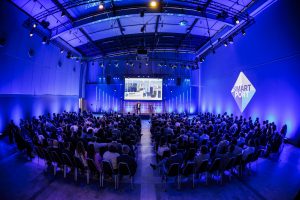
Knowledge Sessions by TU Delft
In the morning, Styn and Stefanie attend various TU Delft sessions. One of the sessions that strikes Stefanie most focuses on the domino effects of a fossil-free chemical industry. “One company’s waste stream is often another company’s raw material. That makes circularity possible. But it also makes it very complex.” She is surprised by how interconnected the port cluster is. “If one plant changes its raw material, it can have consequences for ten other companies.”
Styn attends the same session and is particularly impressed by how the speaker began her presentation. “She started with the game Tetris to explain a technical subject. It was a very nice bridge to something very complicated.” He says that the combination of simplicity and depth helped him understand the subject better.
The Keynote by Hans Stegeman
The knowledge session is followed by The Keynote by economist Hans Stegeman. Styn already knew him from his master’s program and recognized many of the concepts. “He uses frameworks that I also encountered during my studies. That makes it even more interesting.” He particularly notes that Stegeman deliberately invites the audience to be critical. “He invites those present to engage in conversation with him if they disagree with him. That makes for a very interactive discussion.”
Afternoon Case Studies
In the afternoon, all participants work on practical case studies tied to current issues in the sector.
Styn and the Small Modular Reactor
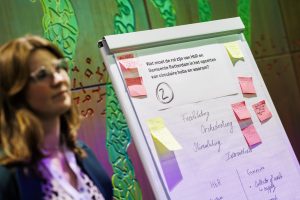
Styn is working on a case about Small Modular Reactors. These small nuclear reactors can help reduce grid congestion on the Maasvlakte. “I have already worked on this during my studies. The theme immediately appealed to me.” During the workshop, his team had to gather information from other groups within five minutes. He says: “That was intense. I didn’t know anyone in the group. Everyone came from a different background, such as lawyers or people from the Ministry of Economic Affairs. That made it very interesting.”
Stefanie and the Circular Hub
Stefanie is working on a case study for the municipality of Rotterdam about circular hubs in the port. “The municipality knows that circularity is important, but they don’t yet know exactly how to get started.” She finds it remarkable that there are no fixed frameworks yet. “Everyone has different ideas about what a circular hub should be. I find it valuable to hear that there is still a lot of room for discovery.” The case study ties in with her previous experience at BlueCity, where she conducted research into circularity.
The Anthropologist Who Kept Everyone Awake
A session that left a strong impression on both was the keynote speech by anthropologist Jitske Kramer. She spoke about liminality, which is the phase between the old and the new. Stefanie recognized this immediately. “‘I am no longer a student, but I am not yet fully embedded in the maritime sector. It is reassuring to hear her say that it is normal not to have all the answers yet. ”
Styn was impressed by Jitske’s energy. “She really made everyone laugh. I thought that was impressive.” He says that the session made him realize that change is also about people and behavior.
Networking That Never Stops
Throughout the day, Styn speaks with many new people and notices how quickly connections form in the maritime world. A contact he spoke to in the morning at SmartPort, he encountered again later at Venturn Connect. “That’s coincidental. It shows how small and connected the sector is.” He also says that he immediately took the initiative towards a possible new assignment. According to him, this fits in well with the intention of SmartPort.
What They Take Away From the Day
For Stefanie, SmartPort has given clarity on which topics she wants to explore further, with circularity now high on her list. Styn emphasizes that he is especially inspired by the amount of knowledge and energy within the sector. “That motivates me to remain curious and to continue talking to people in the port.”
About Venturn Young Professionals
The Venturn Young Professionals programme is a two-year traineeship in which young professionals develop their skills within the maritime and logistics sector. They do this through assignments, training courses, and events such as the SmartPort. The programme helps them develop both professional and personal skills.


