“Perfection kills creativity”
That statement was the key insight that stayed with Styn Mulderink after the Design Thinking training sessions within the Venturn Young Professionals program. ”I noticed that I often test ideas for feasibility before I share them. This training showed me that doing so can actually block creativity.”
In recent weeks, all VYP participants took part in a series of Design Thinking sessions organized by Yellow Perspective and facilitated by Maarten Roos. The approach was energetic and interactive. No long presentations, but mainly assignments, discussions, and reflection. “Maarten didn’t stand in front of the group with endless slides. He guided us as a facilitator by asking the right questions, challenging us, and made sure everyone actively participated.” The atmosphere was open and approachable. There was room to experiment, make mistakes, and think beyond the beaten path.
Learning to look differently at a problem
One of the first exercises revolved around a mid-sized museum with a declining number of visitors. Families and young people were staying away; visitors spent less time there and described the museum as ”beautiful but not surprising”. The question was how the museum could encourage people to stay longer and enjoy their visit more.
Instead of immediately thinking of solutions, framing was central. Looking at the problem from different perspectives. Styn worked with his group on the Interactive Learning Frame and the Additional Experience Framework. ”This exercise showed me how important framing is. The same situation can have completely different solutions depending on how you frame the problem, and that can lead to entirely different outcomes. ”
According to Styn, this was an important first step: not thinking in terms of end solutions right away but consciously choosing how you approach the problem.
Creating space for creativity
An important theme during the sessions was the principle: diverge first and then converge.
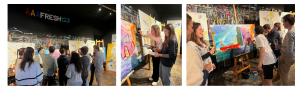
The group started with brainwriting. Everyone individually developed ideas on the same A3 paper, after a time limit you had to pass on the paper you were working on and work on another A3 until all papers had passed everyone at least once. An improved version of the well-known brainstorm. This was followed by analogy thinking. Techniques and solutions from other sectors were used as inspiration for challenges in our domain. They also worked with storyboard ideation, visually mapping out ideas step by step.
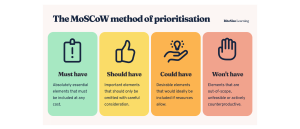
The MoSCoW model states that ideas should be prioritized in: must have, should have, could have, and won’t have.
A striking exercise involved using everyday objects, such as a toothbrush or ladle as inspiration for an alternative idea. ”That forced me to break away from fixed associations and really think outside the box. At first it felt strange, but precisely because of that the process became much smoother and more creative.”
Tackling complex challenges step by step
During the later sessions, the focus shifted to complex challenges. Problems with many interconnected and unpredictable factors, for which no simple solution exists. The VYP participants were introduced to the difference between intuitive and analytical thinking. They also worked with the seven steps of Design Thinking: Understand, Empathize, Define, Ideate, Prototype, Test, and Implement.
What made the biggest impression on Styn was the importance of truly understanding the problem before thinking about solutions. “You really have to sketch out the problem first with everything involved and then work towards a valid solution.”
Breaking down the context, understanding who is affected by the problem, and truly listening to users proved to be a crucial first step. It was also emphasized that saying is not the same as doing. People may indicate what they want, but their behavior sometimes tells a different story.
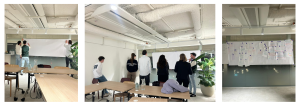
The group literally wrote down everything, even the most bizarre ideas. The example of the robot vacuum cleaner was the inspiration for this, once also considered a crazy idea, showed that innovation often starts with something that initially seems unrealistic.
An insight that stays with you
For Styn, the biggest eye-opener was the principle: Perfection kills creativity.
”I’ve learned to see ideas more as a starting point rather than a solution that needs to be developed. Great ideas don’t have to be perfect right away. They’re allowed to grow through feedback and collaboration.”
He is taking that insight with him into his assignment. By first clearly defining the problem and creating space during brainwriting before selecting ideas, he believes more quality emerges with this approach.
Development within the VYP program
The Design Thinking training is part of the two-year Venturn Young Professionals program. Within this traineeship, young professionals combine assignments in the maritime and logistics sector with targeted training in hard and soft skills to keep developing.
For Styn, these sessions confirmed how important it is to consciously reflect on how you think, analyze, and create. ”It has helped me to not immediately jump to conclusions in the first phase and to be more open for the creative process.”
Are you curious about what it’s like to continue developing yourself both professionally and personally within the maritime and logistics sector? Discover the Venturn Young Professionals program and take your next step.


